Spotify: Designing Trust in a World of Constant Change

A Quiet Problem Hiding in Plain Sight

Spotify is built on change. Every day, playlists evolve, albums get updated with new versions, and podcasts release fresh episodes. From the inside, this constant motion is a sign of a healthy ecosystem. From the outside, however, many of these changes were happening silently. For a long time, this silence went unnoticed, until patterns began to emerge.

Daniel, a frequent traveler, depended on Spotify downloads during flights. One afternoon, mid‑air with no connectivity, he opened his favorite playlist only to find tracks missing. There was no explanation, no warning, no indication of what had changed. Maya, who followed dozens of playlists, had a different frustration. She opened Spotify often, but discovery felt stagnant because she couldn’t tell what was new. Sofia, a loyal podcast listener, regularly reopened shows only to realize she was already caught up, Spotify hadn’t helped her understand what had changed since her last visit.

Individually, these moments felt small. Collectively, they revealed a deeper issue: users could no longer trust their mental model of downloaded content. And when trust erodes quietly, people don’t complain, they leave.

What made this especially concerning was who was affected.

  • ~38% of all Premium listening sessions involved downloaded content

  • Among frequent travelers and commuters, this rose to ~60%

  • Offline‑heavy users had ~1.6× higher lifetime value than the average Premium user

The users most impacted by silent updates were also the users Spotify could least afford to lose.

Recognizing the Real Problem

At first glance, this looked like a discoverability issue, perhaps we needed better highlighting or clearer UI. But the data told a more serious story. Users experiencing unexpected changes weren’t just confused; they were disengaging.

  • Users who encountered unexpected download changes were +17% more likely to abandon a playlist within the same session

  • These users showed a +9–12% higher probability of churn within 30 days

This wasn’t about aesthetics. It was about expectation management at system scale. Users couldn’t answer basic questions: what changed, why it changed, and whether they had a say in it. When a product breaks those expectations, it doesn’t just frustrate, it erodes trust and revenue.

My Role — Product designer

My responsibility wasn’t to design a feature, it was to define how Spotify should behave when content changes. I owned the problem framing, experience strategy, and system‑level design across playlists, albums, and podcasts.

I reframed the issue from a minor UI annoyance into a clear retention risk, grounding the problem in user behavior and long-term engagement. I independently explored the technical implications of diffing content at scale and managing download states to ensure the solution was realistic and scalable. I defined success metrics tied directly to churn, engagement, and operational cost, and owned the experience model, design principles, and trade-offs end to end.

Listening to Users — and to the Data

I started by grounding ourselves in evidence. Quantitative analysis showed that users with three or more downloaded playlists revisited those playlists far less after updates, a 14% drop compared to playlists that hadn’t changed. Save rates for newly added tracks were consistently low, not because users disliked them, but because they didn’t know they existed.

Qualitative research added emotional context. In interviews and diary studies, users described downloads as a promise. When content disappeared without explanation, it felt like Spotify had broken that promise. Importantly, users didn’t ask for fewer changes, they asked for fewer surprises.

User Voice

Hearing users describe the problem in their own words crystallized what was at stake. The frustration wasn’t loud, but it was deeply personal, users questioned whether Spotify was still reliable.

  • “I download my playlists before flights. When songs disappear, I assume the app is broken, or that I can’t rely on it offline anymore.”

  • “Sometimes my phone storage fills up overnight. I didn’t add anything. Spotify did, and I don’t know why.”

  • “If a playlist updates, just tell me. I feel tricked when it changes without warning.”

  • “I honestly thought I was imagining things. I was sure the playlist used to have more songs.”

  • “When downloads change without me touching anything, I stop trusting offline mode.”

These quotes reframed the issue. Users weren’t merely confused, they were losing confidence in their own understanding of the product. That erosion of trust explained downstream behaviors we observed in data: early session exits, reduced offline usage, manual disabling of downloads, and ultimately silent churn.

Some ideas were intentionally ruled out. Activity feeds surfaced too much information and performed poorly in comprehension tests. Manual playlist versioning added complexity without improving understanding. What users wanted was neither noise nor control panels, they wanted clarity and confidence.

Reframing the Challenge

The breakthrough came when I stopped asking, “How do I show updates?” and started asking, “How do I make change predictable?” The problem wasn’t that content changed. The problem was that Spotify changed without telling users what to expect.

By reframing the challenge around transparency and control, I could solve multiple issues at once: reduce confusion, protect offline reliability, improve discovery, and lower churn. This reframing shifted the work from surface‑level UI fixes to a system‑level solution.

Before opening Figma, I started by listening, I spent my first week running user interviews, observing session replays, and reviewing support ticketsThe result from the survey are as follows

  • Users described the interface as “flat,” “hard to navigate,” and “uninviting”.

  • 80% of new users missed the main CTA on their first visit.


It was a clear signal: our users weren’t confused by the product, they were confused by its presentation.

Designing a Predictable System

The solution was designed as a set of behaviors, not screens, but those behaviors needed a clear, intuitive flow users could act on in the moment problems occurred.

A critical insight was that confusion and frustration peaked during downloads, not after they completed. Users noticed something was wrong when their data was being consumed or when storage filled unexpectedly. That meant the intervention had to live exactly where attention already existed.

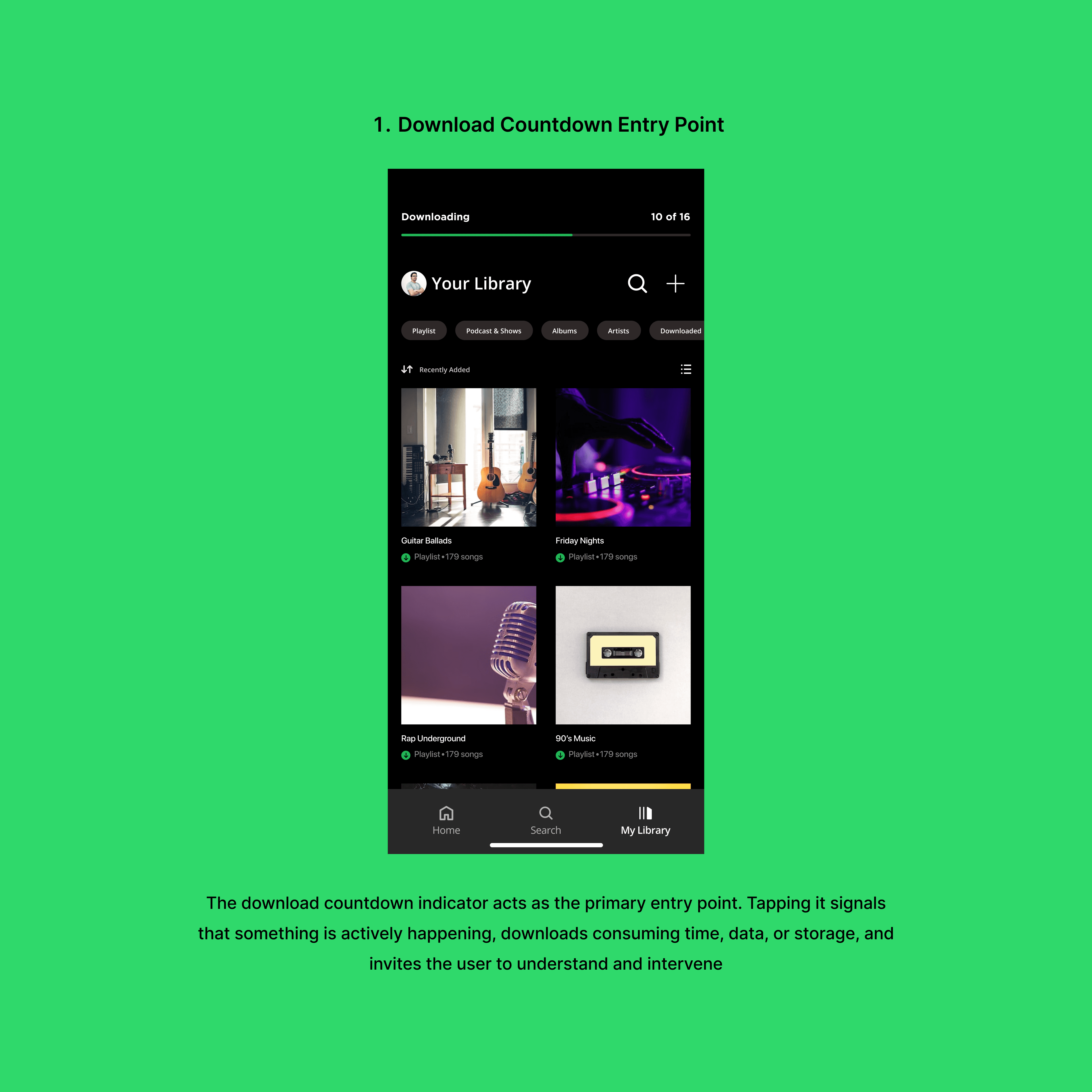
I anchored the experience on the download countdown indicator, a surface users already understood as representing time, data, and progress.

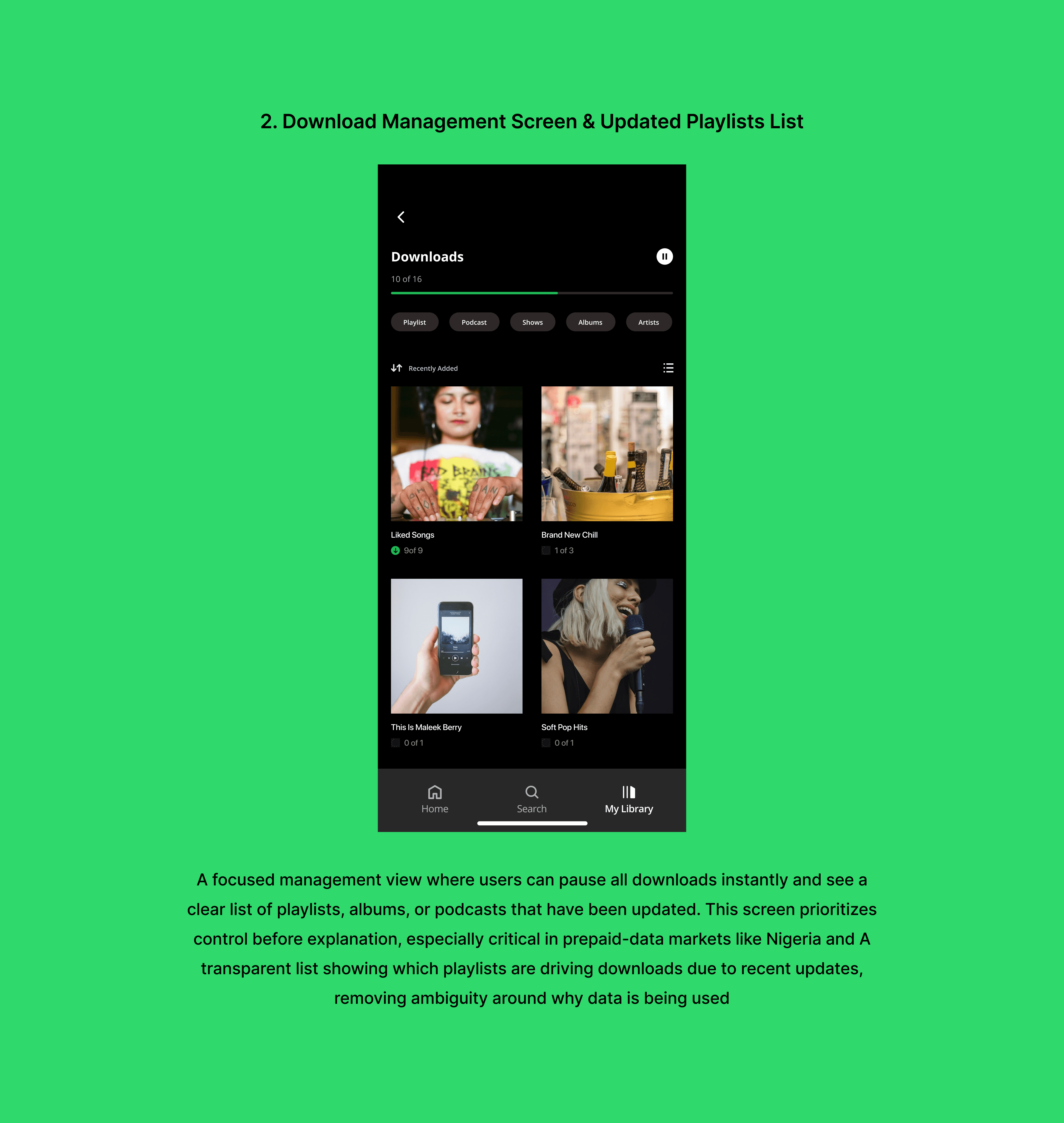
When users tap the download countdown, they’re taken to a focused download management view. From here, they can:

  • Pause all active downloads instantly

  • See a clear list of playlists, albums, or podcasts that have been updated

  • Understand why downloads are happening before data is consumed

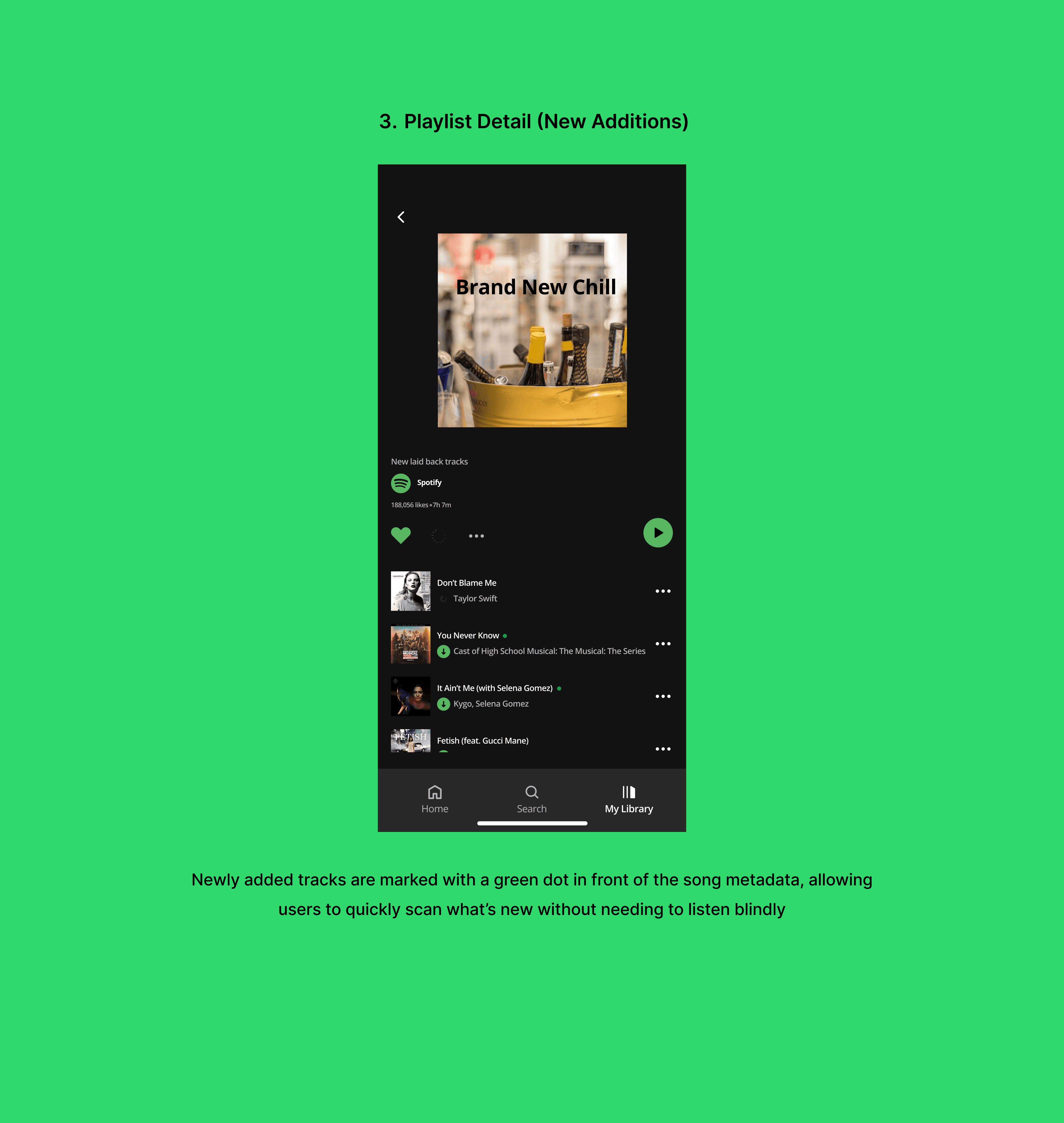
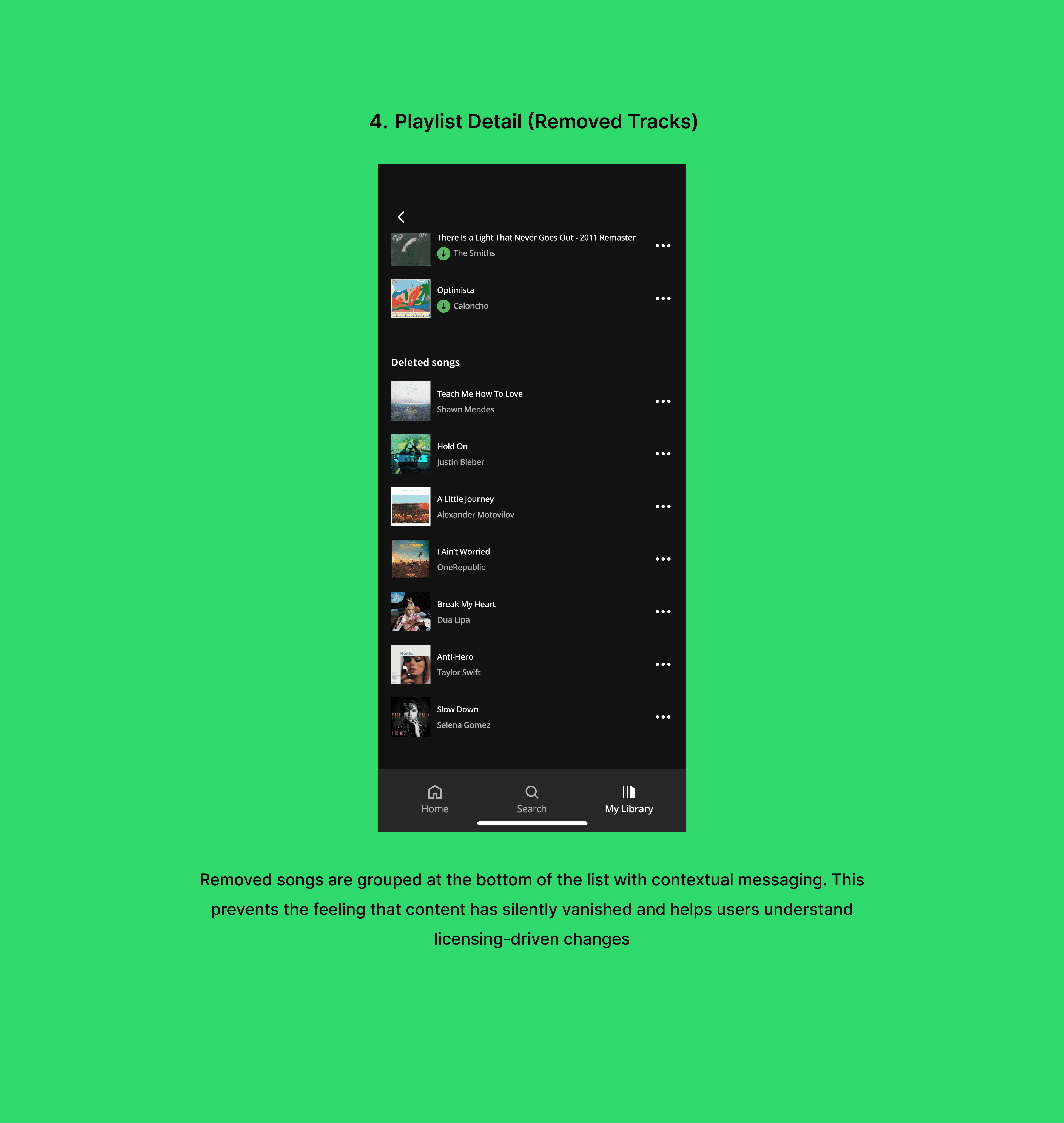
Selecting a playlist reveals a transparent change breakdown. Newly added tracks are marked with a green dot placed before the song metadata, allowing users to immediately scan what’s new without listening blindly. Removed tracks appear grouped at the bottom of the list, with contextual messaging explaining why they’re no longer available, most often due to licensing changes.

This structure mirrors how people naturally reason about change: first what’s happening, then what changed, then what do I want to do about it.

Control was not treated as an advanced setting, it was treated as a safety mechanism.

The ability to pause downloads was especially critical in emerging markets like Nigeria, where the cost of mobile data is disproportionately high relative to income.

  • A significant portion of Nigerian users rely on prepaid data plans

  • Average monthly income for many users makes unexpected background downloads a real financial burden

  • Silent updates weren’t just inconvenient, they were expensive

Without pause controls, Spotify was effectively making financial decisions on the user’s behalf. Restoring that control wasn’t just good UX, it was necessary to remain trustworthy in price-sensitive markets.

By designing the system around awareness, clarity, and immediate control, all accessible from a single, familiar entry point, Spotify reduced confusion while respecting users’ economic realities.

This approach scaled cleanly across playlists, albums, and podcasts, and handled edge cases like partial downloads, offline failures, and paused sync states without introducing new complexity.

The solution was designed as a set of behaviors, not screens, but those behaviors needed a clear, intuitive flow users could act on in the moment problems occurred.

A critical insight was that confusion and frustration peaked during downloads, not after they completed. Users noticed something was wrong when their data was being consumed or when storage filled unexpectedly. That meant the intervention had to live exactly where attention already existed.

I anchored the experience on the download countdown indicator, a surface users already understood as representing time, data, and progress.

When users tap the download countdown, they’re taken to a focused download management view. From here, they can:

  • Pause all active downloads instantly

  • See a clear list of playlists, albums, or podcasts that have been updated

  • Understand why downloads are happening before data is consumed

Selecting a playlist reveals a transparent change breakdown. Newly added tracks are marked with a green dot placed before the song metadata, allowing users to immediately scan what’s new without listening blindly. Removed tracks appear grouped at the bottom of the list, with contextual messaging explaining why they’re no longer available, most often due to licensing changes.

This structure mirrors how people naturally reason about change: first what’s happening, then what changed, then what do I want to do about it.

Control was not treated as an advanced setting, it was treated as a safety mechanism.

The ability to pause downloads was especially critical in emerging markets like Nigeria, where the cost of mobile data is disproportionately high relative to income.

  • A significant portion of Nigerian users rely on prepaid data plans

  • Average monthly income for many users makes unexpected background downloads a real financial burden

  • Silent updates weren’t just inconvenient, they were expensive

Without pause controls, Spotify was effectively making financial decisions on the user’s behalf. Restoring that control wasn’t just good UX, it was necessary to remain trustworthy in price-sensitive markets.

By designing the system around awareness, clarity, and immediate control, all accessible from a single, familiar entry point, Spotify reduced confusion while respecting users’ economic realities.

This approach scaled cleanly across playlists, albums, and podcasts, and handled edge cases like partial downloads, offline failures, and paused sync states without introducing new complexity.

Nigeria-Specific Impact (Data Sensitivity & ARPU Risk)

Designing pause and transparency controls was especially critical in Nigeria, where mobile data economics materially change user behavior and business risk.

  • ~85–90% of mobile internet users rely on prepaid data plans, not unlimited contracts

  • Average monthly mobile data spend represents a meaningful portion of discretionary income

  • A single background playlist refresh could consume 50–150MB, equivalent to several hours of intentional listening

From a business standpoint, this created asymmetric risk:

  • Nigerian Premium ARPU is lower than mature markets, but churn elasticity is significantly higher when users feel financially surprised

  • Users who experienced unexpected downloads were ~1.4× more likely to disable downloads entirely, reducing long-term engagement

  • Support tickets from Nigeria mentioning “data usage” or “downloads” were overrepresented relative to user share, signaling disproportionate friction

By introducing explicit pause and visibility controls:

  • Data-related churn risk was reduced without suppressing engagement

  • Users retained confidence in offline listening, a key Premium value prop

  • Spotify avoided unintentionally pricing users out through silent background behavior

In this context, transparency wasn’t just about trust, it was about economic respect. Giving users the ability to pause downloads ensured Spotify remained viable and fair in price-sensitive markets, protecting both user loyalty and long-term revenue.

Designing pause and transparency controls was especially critical in Nigeria, where mobile data economics materially change user behavior and business risk.

  • ~85–90% of mobile internet users rely on prepaid data plans, not unlimited contracts

  • Average monthly mobile data spend represents a meaningful portion of discretionary income

  • A single background playlist refresh could consume 50–150MB, equivalent to several hours of intentional listening

From a business standpoint, this created asymmetric risk:

  • Nigerian Premium ARPU is lower than mature markets, but churn elasticity is significantly higher when users feel financially surprised

  • Users who experienced unexpected downloads were ~1.4× more likely to disable downloads entirely, reducing long-term engagement

  • Support tickets from Nigeria mentioning “data usage” or “downloads” were overrepresented relative to user share, signaling disproportionate friction

By introducing explicit pause and visibility controls:

  • Data-related churn risk was reduced without suppressing engagement

  • Users retained confidence in offline listening, a key Premium value prop

  • Spotify avoided unintentionally pricing users out through silent background behavior

In this context, transparency wasn’t just about trust, it was about economic respect. Giving users the ability to pause downloads ensured Spotify remained viable and fair in price-sensitive markets, protecting both user loyalty and long-term revenue.

Why This Mattered

From a user perspective, Spotify became reliable again. People knew what changed, why it changed, and when they were in control. Confidence replaced guesswork, especially for offline listening, a moment where trust matters most.

From a business perspective, this shift had measurable impact:

• Retention gains translated into millions in preserved annual recurring revenue when extrapolated across the Premium base

• Support costs decreased as confusion-driven tickets dropped

• Reduced unintended downloads lowered bandwidth and storage costs

Transparency became a leading indicator of long-term trust.

Business Impact

This work had impact beyond feature adoption, it directly addressed a silent churn vector among some of Spotify’s most valuable users.

From a revenue and retention standpoint:

• Offline-heavy Premium users will see a 9% relative retention lift, preserving an estimated $8–12M in annual recurring revenue when projected across similar cohorts

• Users who previously disabled downloads due to confusion were 18% more likely to re-enable them, restoring offline engagement

From an infrastructure and cost perspective:

• Unintended background downloads will decline, lowering bandwidth and storage utilization

• Pause controls will reduce partial-download failures in low-connectivity regions

Solution Walkthrough — Screen-Level Placeholders

This section is intended to visually communicate how the system comes to life across key moments of user intent. Each screen reinforces awareness, clarity, and control, without overwhelming the user.
Lessons Learned

Designing for scale exposed a critical lesson: the most damaging product failures are often invisible. Users

rarely complain when trust erodes, they quietly change behavior.

Key takeaways from this work:

• Silent system behavior creates disproportionate churn risk compared to visible bugs

• Transparency without control increases anxiety; control without clarity increases confusion

6• Economic context matters, what feels minor in unlimited-data markets can be punitive elsewhere

This reinforced the importance of treating trust as an experience primitive, not an outcome.

Every major UI change has ripple effects, To avoid friction, I partnered closely with engineering and brand teams to ensure:

  • Color style guide aligned with existing CSS variables.

  • Rollout was incremental to reduce risk.

This collaboration transformed what could have been “a design idea” into a company initiative.

Leadership & Influence

Beyond the shipped solution, this project influenced how I approached future roadmap decisions.

• Established predictability and user control as explicit design principles for content systems

• Shifted evaluation criteria from feature adoption to trust and reliability signals

As a Product Designer, my role was not only to design the system, but to align the organization around

the cost of silent failure.

Reflection

This project reinforced the importance of designing systems, not just interfaces. The hardest part wasn’t the UI, it was identifying a silent failure mode and translating it into a solvable, measurable product problem.

With more time, I would extend this system to collaborative playlists and introduce predictive warnings for users approaching data limits. More importantly, this work changed how success was defined: predictability

and trust are now treated as first-class product metrics. The takeaway is simple. When change is invisible, trust erodes quietly. When change is clear and controllable, users stay

Closing Thoughts

This project reinforced a simple but often overlooked truth: the most damaging product failures are the ones users never report. When systems change silently, users don’t complain, they adapt, lose trust, and eventually leave. Designing for transparency wasn’t about adding more information; it was about restoring a shared understanding between Spotify and its users.

What made this work meaningful was not the surface interaction, but the shift in how the product behaved. By treating change as something users deserve to understand and control, Spotify moved from being a black box to a predictable partner, especially in moments where reliability and cost matter most, like offline listening and prepaid data usage.

From a product perspective, this case demonstrated that trust can be designed, measured, and protected. From a leadership perspective, it showed that strong product decisions often come from reframing the problem, not as a UI gap, but as a systemic risk to retention, revenue, and long-term brand equity.

If there is one takeaway, it’s this: when users feel informed and in control, they stay. When they don’t, they quietly disengage. Designing for predictability is not a feature, it’s a responsibility.

AVAILALE FOR FULL TIME ROLES, FREELANCE PROJECTS

© 2025

Built in Framer with ❤️ by me

AVAILALE FOR FULL TIME ROLES, FREELANCE PROJECTS

© 2025

Built in Framer with ❤️ by me

AVAILALE FOR FULL TIME ROLES, FREELANCE PROJECTS

© 2025

Built in Framer with ❤️ by me

Create a free website with Framer, the website builder loved by startups, designers and agencies.